


Just a few meters from the chaotic flow of students coming and going at the Universidad de Santiago metro station, there is a corner of the campus that seems to move at a different pace.
The Jotabeche area, surrounded by trees and classrooms, takes its name from the historic church located across Alameda Avenue. There stands the Food Research Building, whose façade gives no hint that, behind those walls, research is underway to answer some of the most pressing questions facing today’s food industry. It is there that Dr. Silvia Matiacevich, a faculty member in the Department of Food Science and Technology, welcomes us.
The researcher immediately apologizes for the noise. The building is undergoing extensive remodeling and expansion, and the comings and goings of workers coexist daily with the laboratory’s routine. Amid construction cables and the constant flow of researchers through the hallways, the experiments continue. And that is precisely where this story begins.
For the past four years, this place has been the hub of the Fondecyt Regular project “Nut byproduct valorization through natural additive design: effect of storage conditions on the stability of active compounds in a real food matrix (cream cheese)”, a research effort that sought to find value where others saw waste, transforming discarded materials from the nut industry into ingredients capable of protecting fresh foods and delaying their spoilage.
Currently, the nut industry generates thousands of metric tons of waste each year. Shells, skins, and other byproducts that, in most cases, are sent for composting, used as animal feed, or simply discarded. Although various initiatives to repurpose them have been promoted in recent years, none have been geared toward the food industry.
“It all started when we met a walnut producer who told us he was accumulating large quantities of green husks and didn’t know what to do with them. That’s when the idea arose to repurpose that waste and study whether it was possible to extract natural compounds with antioxidant properties from it,” Silvia tells us in her distinctive trans-Andean accent.
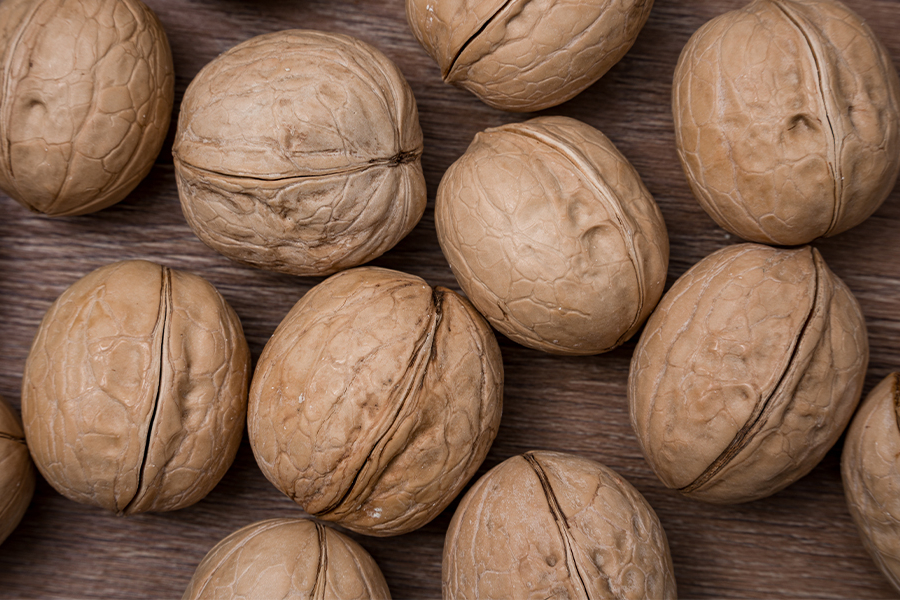
Nuts are packed with natural compounds that slow food spoilage. In walnuts, these preservatives are concentrated in the green husk—an outer layer removed during harvest and usually thrown away as waste once the fruit ripens.
That is where the polyphenols are found—natural plant-based compounds with high antioxidant capacity. “We selected polyphenols because the literature indicated that the green walnut shell had a high concentration of these compounds. Upon verifying their antioxidant activity, we set out to develop a natural additive capable of extending the shelf life of food,” explains the researcher.
Protecting these compounds then became the main challenge of the research, and a solution was found in an encapsulation system based on chickpea proteins, capable of forming a protective barrier around the polyphenols. In this way, the antioxidants were able to withstand processing conditions, remain stable, and maintain their effect once incorporated into actual food.
“Through encapsulation with chickpea proteins, we were able to obtain a natural antioxidant that remained stable over time and retained its activity within a real food product. That was the project’s main milestone,” explains Silvia Matiacevich.
Although this breakthrough occurred on a laboratory scale, it addresses the broader challenge and need to develop foods with a longer shelf life using natural ingredients. In a context where consumers, regulations, and the industry are moving toward reducing synthetic additives, finding alternatives that are just as effective has become a priority for the food sector.
The work didn’t end there: now they had to demonstrate that the additive actually worked, and the result was “cream cheese, because it’s a fresh product with lipophilic properties—that is, it has a high fat content, and fats tend to oxidize. “Compared to a synthetic additive, we saw that the one we developed performed similarly and was even up to 10% more effective at extending its shelf life,” the researcher notes.
Over three years of research, the project achieved far more than just creating a natural additive to extend food shelf life. It pioneered new applications for agro-industrial waste, mentored the next generation of undergraduate and graduate students, and established an active collaborative network with leading national and international researchers.
“The main milestone was the development of the product, but we also produced four scientific publications, involved six food engineering students, one master’s student, and a doctoral thesis. We also strengthened collaborations with universities in Chile and abroad,” says the researcher.
Today, the question is no longer just finding a use for nut industry waste, but discovering how many other foods could thrive because of it.
“This project demonstrated that agro-industrial waste can be transformed into an ingredient with high potential for the food industry. Now the challenge is to get companies interested in developing these types of products and to coordinate the entire supply chain, from obtaining the waste to incorporating it into new foods,” reflects Silvia Matiacevich.